http://www.youtube.com/channel/REPLACE_WITH_ID?sub_confirmation=1
Monday, 12 August 2019
How to make a YouTube subscription link and get more subscribers
http://www.youtube.com/channel/REPLACE_WITH_ID?sub_confirmation=1

Friday, 9 August 2019
Tamil to English counting money
100 one hundred (nooru) நூறு
200 two hundred (eru nooru) இருநூறு
300 three hundred (mun nooru) முன்னூறு
1000 one thousand (aayiram) ஆயிரம்
2000 two thousand (rendu aayiram) இரண்டு ஆயிரம்
100,000 hundred thousand (oru latcham) ஒரு இலட்சம்
1,000,000 one million (pathu latcham) பத்து இலட்சம்
10,000,000 ten million (oru kOdi) ஒரு கோடி
1,000,000,000 one thousand million, one billion (nooru kOdi) நூறு கோடி
1,000,000,000,000 one trillion (latcham kOdi) இலட்சம் கோடி
200 two hundred (eru nooru) இருநூறு
300 three hundred (mun nooru) முன்னூறு
1000 one thousand (aayiram) ஆயிரம்
2000 two thousand (rendu aayiram) இரண்டு ஆயிரம்
100,000 hundred thousand (oru latcham) ஒரு இலட்சம்
1,000,000 one million (pathu latcham) பத்து இலட்சம்
10,000,000 ten million (oru kOdi) ஒரு கோடி
1,000,000,000 one thousand million, one billion (nooru kOdi) நூறு கோடி
1,000,000,000,000 one trillion (latcham kOdi) இலட்சம் கோடி
Wednesday, 13 February 2019
Hanuman Chalisa predicts Distance between Sun and Earth
Hanuman Chalisa predicts Distance between Sun and Earth

Hanuman Chalisa was composed by Gosvami Tulasidasa. He was a great devotee of Lord Ramachandra who lived in the 16th century. He composed the Rama-charita-manasa, the epic story of Lord Rama retold in the vernacular language. Many devotees regularly recite Hanuman Chalisa, a prayer glorifying Shri Hanuman, composed by this great saint and poet.
It is believed that in one of these verses of Hanuman Chalisa, Tulasidasa had given an accurate calculation of the distance between the Sun and Earth.
The Quest of Astronomers to find the distance of Sun
The Greek Astronomers were known for their contribution to the scientific field in understanding the heavenly bodies.
- Archimedes, an ancient Greek Mathematician and Philosopher of the 3rd century BC, estimated the distance of Sun from Earth as 10000 times the radius of Earth.
- Later, Hipparchus (2nd century BC) gave an estimate of 490 times the radius of Earth.
- Ptolemy considered the distance to be 1210 times the radius of Earth.
However, Johannes Kepler (1571–1630), a German Mathematician and Astronomer realized that these estimates were significantly low. Kepler’s law of Planetary Motion allowed astronomers to calculate the relative distance of the planets from Sun. This was also aided by the invention of telescope in the beginning of the 17th century which helped them to get more accurate measurements.
However the most modern calculations in 20th century estimate the distance to be somewhere around 23455 times the radius of Earth (149,431,805 kms assuming radius of Earth to be 6371 kms).
Srila Prabhupada writes in one of his purports:
Modern scientific calculations are subject to one change after another, and therefore they are uncertain. We have to accept the calculations of the Vedicliterature. These Vedic calculations are steady; the astronomical calculations made long ago and recorded in the Vedic literature are correct even now. Whether the Vedic calculations or modern ones are better may remain a mystery for others, but as far as we are concerned, we accept the Vedic calculations to be correct.
According to modern calculation:
Average distance between the Sun and Earth =149 million kms = 92 million miles.
However, the orbit of the Earth is not a perfect circle, but an ellipse. Sometimes the Earth is closer to the Sun and sometimes it is farther.
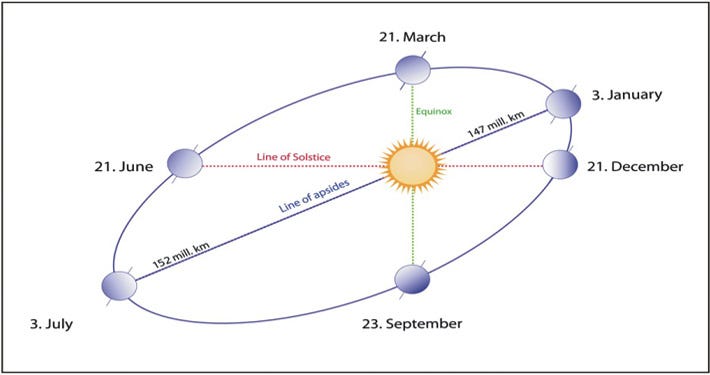
Shortest distance between Sun and Earth (perihelion) = 91 million miles = 147 million kms (early January)
Longest distance between Sun and Earth (aphelion) = 94.5 million miles = 152 million kms (early July)
It is surprising to note that Tulasidasa who lived in 16th century could give the most accurate estimation that is very close to the estimation by 20th century astronomers.
Let us decipher the calculation in Hanuman Chalisa…
Hanuman, in his childhood, assuming the Sun to be a ripe mango, jumped to catch it. Tulasidasa recounts this incident in his Hanuman Chalisa as follows:
yuga-sahasra-yojana para bhanu
leelyo tahi madhura phala janu
leelyo tahi madhura phala janu
Considering the Sun to be a sweet fruit, Hanuman jumped to swallow it.
Here the distance he travelled is mentioned as yuga-sahasra-yojana. Let us try to decipher this.
What is a yuga? According to Bhagavad-gita, one day of Brahma is called kalpa and is equal to 1000 yugas and this is followed by a similar duration of night.
sahasra-yuga-paryantamaharyadbrahmanoviduh
ratrim yuga-sahasrantamte ‘ho-ratra-vidojanah
ratrim yuga-sahasrantamte ‘ho-ratra-vidojanah
1 yuga = 4,320,000 years = 12000 divine years
(1 divine year = 360 years according to human calculation)
This is also confirmed in Manu-samhita: etad dvaadasha sahasram devanam yugamuchyate
According to the above verse from Hanuman Chalisa, the distance between Sun and Earth is
yuga-sahasra-yojana = 12000 x 1000 yojanas.
Yojana is a Vedic measure of distance and approximately equals to 8 miles (according to the 14th century scholar Parameshvara, the originator of drgganita system). And 1 mile = 1.60934 kilometers.
According to the calculation presented in Hanuman Chalisa
Distance between Sun and Earth = 12000 x 1000 yojanas = 96 million miles = 153.6 million kms, which is much closer to the calculation of the modern scientists.
The assumptions we have made in the above calculations are as follows:
- We assumed yuga to mean the number 12000 based on the time calculation system of Vedic period based on the statement from Bhagavad-gita and Manu Samhita.
- We approximated 1 yojana = 8 miles based on what Srila Prabhupada has mentioned in his purports. However there is still disagreement among scholars as to whether it is 5 miles or 8 miles. Some other calculations indicate values ranging from 7.6 miles to 8.5 miles.
But it is astonishing that Tulasidasa mentioned the distance to this level of accuracy as early as in 16th century when the Western astronomers, with the help of telescope, were trying to figure out the distance.
If you enjoyed 💙 this article then give it some claps 👏. Follow me on Medium. Responses welcome below.
Sunday, 6 January 2019
Things happening around you and people mentality
there are differnt works and different kind of people in IT Companies.
Lets start from the Bus driver who takes us from home to office location;
Job : pick people from locations.
driver safely and drop people to office at correct time.
Go to other job after droping people at office.
we will stop over here.
Mentality :
Stress thought (when he become stressed at job ) :
plans to move to other job.(same driving or business )
Lets start from the Bus driver who takes us from home to office location;
Job : pick people from locations.
driver safely and drop people to office at correct time.
Go to other job after droping people at office.
we will stop over here.
Mentality :
Stress thought (when he become stressed at job ) :
plans to move to other job.(same driving or business )
Emotional and Psychology of people working in IT Industry
CONFIDENTIAL :
people just wanted to communicate , they want to know other user stories and they are always curious to know new information in one form or another.
we can broadly categories people into two types,
INTROVERT and EXTROVERT . this categorization may sound familier but the content is interstng.
people just wanted to communicate , they want to know other user stories and they are always curious to know new information in one form or another.
we can broadly categories people into two types,
INTROVERT and EXTROVERT . this categorization may sound familier but the content is interstng.
Subscribe to:
Posts (Atom)